
You have a client whose business partnership has come apart. Maybe it is a deadlock between two fifty-fifty owners, a minority holder who believes the majority has frozen him out, the death of a partner that triggered a buy-sell clause, or a divorce where one spouse owns a closely held company. Whatever the trigger, you have reached the moment where someone has to put a number on the business, and that number is about to be fought over.
This article is written for the attorney, CPA, or financial planner sitting across from that client. The goal is not to sell you on anything. It is to give you a clear, accurate picture of how an independent, credentialed business valuation actually works in a shareholder dispute, why the standard of value drives the result more than almost anything else, and what separates an opinion that survives cross-examination from one that does not.
TL;DR: In a shareholder dispute, the standard of value usually decides the number before any spreadsheet is opened. Most statutory oppression, dissent, and appraisal cases use fair value, which in many states bars minority and marketability discounts; tax, gift, and estate matters use fair market value, which typically applies them. Independence, the right credential, a litigated valuation date, and methodology that withstands a Daubert challenge are what make the opinion hold up. Duran works alongside your firm as a co-advisor, never instead of you.
This article is general information for professional advisors, not legal advice; standards of value and the treatment of discounts vary by jurisdiction and case type. Where a specific state rule cannot be confirmed, it is flagged below.
Duran Advisors is a Gulf South M&A and business brokerage firm based in New Orleans. Our valuation work follows the professional standards published by the NACVA, and we bring the appropriate credentialed analyst to the engagement so the opinion is built to be defended. Founder Joel Duran holds the CVGA, CM&AA, and M&AMI designations, completed NACVA’s valuation education, and has spent 15 years advising owners and their advisors on valuations, sales, and exits across Louisiana, Mississippi, and the wider Gulf South. We do not litigate; we value, and we coordinate with the litigators and accountants who do.
Key Takeaways
– The standard of value (fair value vs. fair market value) is the single biggest driver of the number in a shareholder dispute, and it is set by statute and case law, not by the appraiser.
– Fair value, the standard in most oppression and dissent cases, frequently disallows the minority discount (DLOC); some states also disallow the marketability discount (DLOM), and Louisiana’s statute excludes both.
– The valuation date is often litigated separately and can swing the result as much as the methodology.
– Credentials (ABV, ASA, CVA), genuine independence, and a defensible method are what let an opinion survive a Daubert challenge and cross-examination.
– A neutral, jointly retained appraiser can narrow the fight and lower cost when value, not control, is the real dispute.
When does a shareholder dispute require a business valuation?
A shareholder dispute requires an independent valuation whenever the value of an ownership interest must be fixed and the owners cannot agree on it. The most common triggers are deadlock between equal owners, minority oppression or freeze-out claims, a buy-sell agreement event, the exit or death of a partner, and a divorce in which a closely held business is marital or community property.
Each of these starts the same way: an interest has to change hands, and there is no public market to price it. A deadlock arises when owners with equal control cannot make decisions and one seeks a court-ordered buyout or dissolution.
Minority oppression, sometimes called a freeze-out, occurs when controlling owners cut a minority holder off from distributions, employment, or information, and the statutory remedy is often a mandatory buyout at a court-determined value.
A buy-sell agreement may be triggered by death, disability, retirement, or withdrawal, and the agreement’s own valuation clause governs unless it is silent or ambiguous. And in divorce, a business is frequently the largest asset on the table, which is why we treat the divorce valuation as its own discipline (covered in our companion piece, Divorce and Business Valuation for Attorneys).
The reason these matters land with a credentialed valuator rather than the company’s regular accountant is independence. The number is going to be contested, possibly in front of a judge, and a tax-return book value or an owner’s gut estimate will not survive that scrutiny. For a foundation on how value is built from the ground up, the owner-facing complete owner’s guide to business valuation is a useful primer to share with clients.
Citation capsule: Estimates of how often business partnerships end in a split run high, with one widely cited figure putting the rate near 80 percent, and a Harvard study by Noam Wasserman attributing roughly 65 percent of startup failures to co-founder conflict. Treat these as directional, not precise. (Quinn Emanuel; Wasserman, The Founder’s Dilemmas, cited 2025)
Fair value vs. fair market value: the standard that decides the number
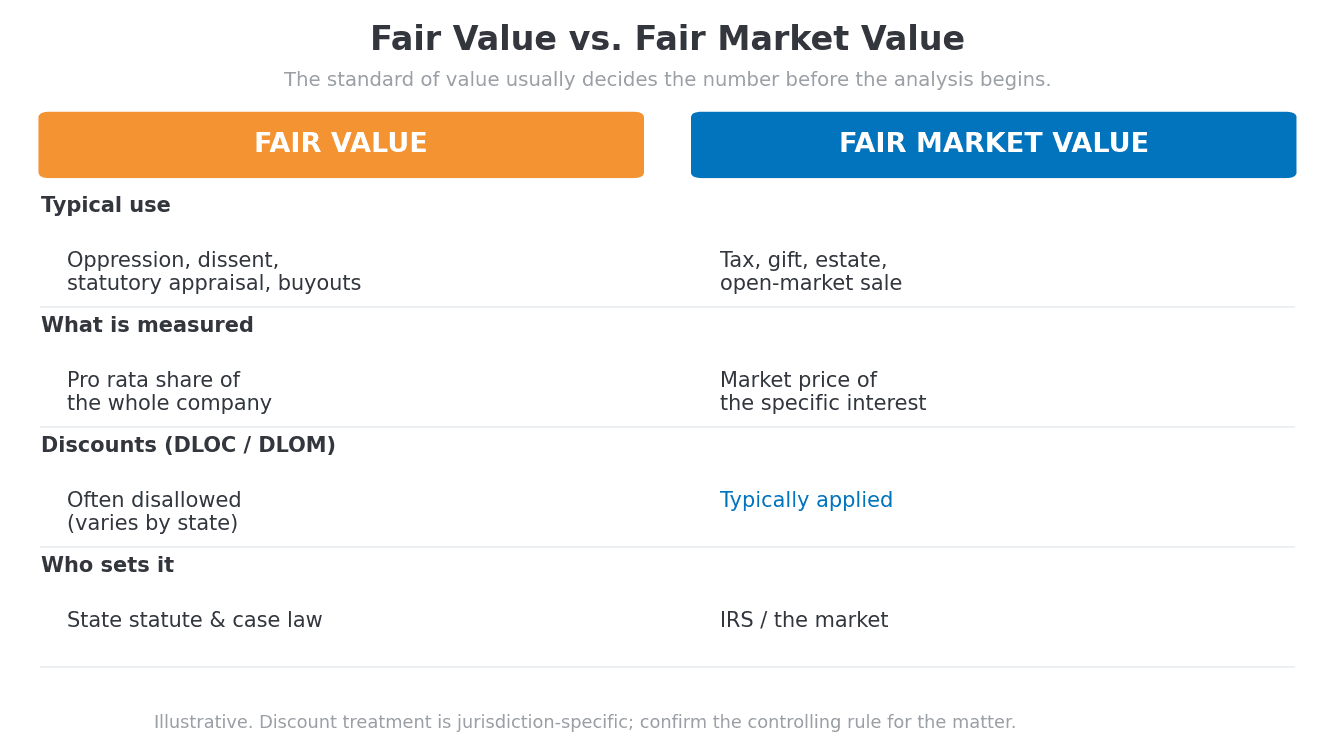
The standard of value is the legal definition of what you are measuring, and it is chosen by statute and case law before any analysis begins. In most shareholder oppression, dissent, and appraisal matters the governing standard is fair value, a statutory construct. In tax, gift, estate, and most open-market sale contexts the standard is fair market value. The two can produce materially different numbers for the same company on the same day.
Fair market value is the classic willing-buyer, willing-seller price in an arm’s-length transaction, with both parties informed and neither under compulsion. It is the IRS standard, and because it imagines a real sale of the specific interest, it usually reflects what that interest is actually worth in the open market, including the practical handicaps of owning a slice of a private company.
Fair value works differently. Rather than pricing the individual interest as it would trade, it generally takes the value of the company as a whole and awards the departing or oppressed owner their proportionate, pro rata share of that enterprise value. The policy behind it is protective: a minority owner forced to sell to the majority should not have the price knocked down simply because the majority holds the power. That single difference, whole-company pro rata versus market price of the specific interest, is what makes the standard of value the most important decision in the entire engagement.
Critically, the standard is jurisdiction-specific. Most states define fair value by statute, often modeled on the Model Business Corporation Act, but the details and the case law interpreting them vary. In Louisiana, the Business Corporation Act defines fair value for the oppression remedy as the value of the shares immediately before the objectionable corporate action, determined without discounting for lack of marketability or minority status. Always confirm the controlling standard for the specific state and cause of action before modeling anything.
Citation capsule: In most states, merger appraisal statutes and judicial dissolution statutes apply the legislative “fair value” standard rather than fair market value, and many courts read fair value as the owner’s pro rata share of the company’s entire value on a controlling, marketable basis. (New York Business Divorce / Farrell Fritz; Mark S. Gottlieb CPA, 2025)
Minority and marketability discounts (DLOC / DLOM): when they apply
Two discounts dominate the fight in private-company valuations. The discount for lack of control (DLOC), also called a minority discount, reflects that a non-controlling owner cannot direct distributions, set strategy, or force a sale. The discount for lack of marketability (DLOM) reflects that a closely held interest cannot be sold quickly or easily because there is no public market and transfer is often restricted. Whether either applies depends almost entirely on the standard of value and the jurisdiction.
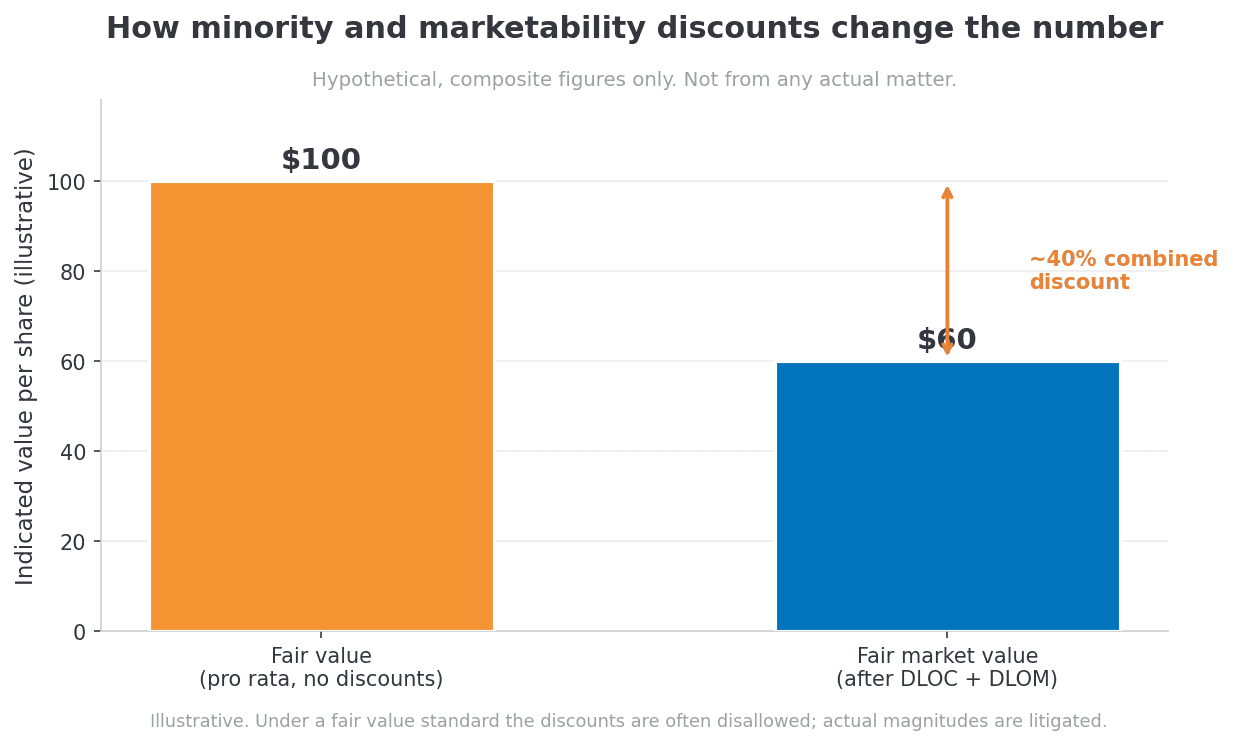
Under fair market value, both discounts are commonly applied to a minority interest in a private company, and together they can reduce the indicated value substantially. Under fair value, the picture changes. Because fair value awards a pro rata share of the whole enterprise, the minority discount is frequently barred outright: courts reason that imposing it would hand the controlling owners a windfall and reward the very conduct the oppression statute exists to prevent. The marketability discount is more contested. Some jurisdictions, such as New York, have at times allowed a marketability discount in fair value proceedings while disallowing the minority discount, and courts have refused even the marketability discount where the controlling parties acted in bad faith. Other states bar both.
Louisiana sits at the protective end of that spectrum. The Louisiana Business Corporation Act defines fair value for the oppression remedy to exclude both lack-of-marketability and minority-status discounts, which is significant because commentators note those discounts can together approach 40 percent of value. For an advisor, the practical takeaway is that you cannot assume a discount will or will not apply; it turns on the standard, the state, the cause of action, and sometimes the conduct of the parties. That is exactly the kind of issue a credentialed valuator should flag at the engagement’s outset, not at deposition.
Citation capsule: In New York statutory fair value proceedings the minority discount (DLOC) is barred while a marketability discount (DLOM) may be permitted, though courts have denied even DLOM where controlling parties acted in bad faith; Louisiana’s Business Corporation Act excludes both discounts from fair value. (New York Business Divorce, 2011 and 2024; Theus Law Offices on La. R.S. 12:1-1435, cited 2025)
Why the valuation date is often the real fight
The valuation date is the single moment in time at which value is measured, and it is frequently litigated as hard as the value itself. A business can look very different on the day a dispute began versus the day of trial, so the choice of date can move the number as much as any methodology. In many oppression and dissent cases the statute or case law points to the value immediately before the corporate action the owner objected to, but the available dates can range across the filing date, the date of the wrongful conduct, or a later trial or buyout-order date.
Why it matters so much: events after the dispute starts, a lost major customer, a pandemic, a surge in earnings, a new contract, can dramatically change value, and each side will argue for the date that favors its client. Under the Model Business Corporation Act framework, fair value is typically measured immediately before the objectionable action and excludes value changes made in anticipation of that action unless excluding them would be inequitable. The credentialed valuator’s job is to value the business as of whatever date the law or the court fixes, and often to prepare alternative conclusions across competing dates so counsel can see the exposure. Pinning down the date early, in consultation with the litigators, prevents a great deal of wasted analysis.
Citation capsule: In shareholder oppression matters the valuation date may be the filing date, the date of the oppressive act, or a post-filing date such as trial or the buyback order; under the Model Business Corporation Act, fair value is generally measured immediately before the objected-to action. (Mark S. Gottlieb CPA; MBCA, cited 2025)
What makes a valuation defensible in litigation
A valuation is defensible when a credentialed, genuinely independent analyst applies a recognized methodology to reliable data, documents the work to professional standards, and can explain and defend every judgment under cross-examination. In a contested matter the report is not the finish line; it is the thing opposing counsel will attack, and possibly the subject of a Daubert challenge to keep the expert off the stand.
Three things carry the weight. First, credentials. The recognized business valuation designations are the AICPA’s Accredited in Business Valuation (ABV), held by CPAs and tied to the AICPA’s Statement on Standards for Valuation Services; the American Society of Appraisers’ ASA in business valuation, which requires years of experience, demonstration reports, and peer review; and NACVA’s Certified Valuation Analyst (CVA). Any of the three can qualify an expert in a litigation setting. Second, independence. A neutral analyst with no stake in the outcome is far harder to impeach than a number produced by a party with an interest. Third, methodology and standards compliance. Following SSVS and NACVA standards, using accepted income, market, and asset approaches, supporting every assumption, and tying conclusions to the record is what makes an opinion survive a Daubert reliability challenge, which tests whether the expert’s method is sound and properly applied.
Duran’s role here is specific and honest about its limits. Our valuations follow AICPA and NACVA professional standards, and we bring the appropriately credentialed analyst to the engagement. Joel Duran has testified as an expert on business value in 2026. We do not hold ourselves out as litigators or as offering a credential we do not have. Where a matter calls for testimony, we make sure the work product is built from the outset to be explained, supported, and defended.
Citation capsule: The principal U.S. business valuation credentials are the AICPA’s ABV (CPAs, governed by SSVS), the ASA in business valuation, and NACVA’s CVA; SSVS compliance and a recognized methodology support defensibility under a Daubert challenge. (AICPA; ASA; NACVA, cited 2025)
Neutral appraiser vs. each side’s expert: choosing the engagement structure
There are two basic ways to bring valuation into a dispute: a single neutral appraiser jointly retained by both sides, or a separate expert hired by each party. The right choice depends on how much trust remains and whether the genuine disagreement is about value or about control. When value is the real issue and the parties can still cooperate at a basic level, a neutral appraiser is often faster, cheaper, and more likely to settle the case.
A jointly retained (neutral) appraiser is engaged by both parties, usually through counsel, to produce one independent opinion of value. Because the analyst is not advocating for either side, the conclusion tends to land between the extremes that opposing experts would otherwise stake out, and it gives everyone a common factual framework for settlement. Many buy-sell agreements build this in directly, naming a single appraiser or a three-appraiser process in which each side’s appraiser tries to agree and a neutral third breaks any impasse. The trade-off is that a neutral works best where there is some baseline trust and where the fight is about the number rather than about who controls the company.
Separate party-retained experts are the traditional litigation posture. Each side controls its own analysis and can probe weaknesses in the other’s, but the result is often competing conclusions, longer timelines, and higher combined cost. The structure is appropriate when the dispute is adversarial to the core, when bad-faith conduct is alleged, or when control itself is contested. Part of what we do early is help counsel weigh which structure fits the matter, because choosing it well can save the client significant cost and time.
Citation capsule: A jointly retained valuation expert provides a single independent opinion that reduces duplication and narrows the range of disagreement, and works best where trust remains and value, not control, is the primary dispute; buy-sell agreements often specify a single or three-appraiser process. (Central Pacific Valuation; Mercer Capital, cited 2025)
How an M&A-grade valuation team integrates with your firm
Duran works as a co-advisor alongside the client’s attorney and CPA, not as a replacement for either. The attorney owns the legal strategy and the standard of value; the CPA owns the tax and accounting record; and we own the independent, credentialed opinion of what the business is worth as of the relevant date under the governing standard. The three roles fit together, and the engagement runs better when they are coordinated from the start.
In practice that means we take the controlling standard of value and valuation date from counsel rather than guessing at them, we draw on the company’s books through the CPA, and we surface the discount and date questions early so they can be litigated on purpose rather than discovered late.
Three things tend to make Duran a useful addition to the advisory team. Our Regional Market Expertise means we understand Gulf South industries, buyers, and comparable transactions firsthand, which grounds the market approach in real local data. Our Coordinated Advisor Collaboration approach is built for exactly this kind of multi-professional matter, where lawyer, accountant, and valuator have to move together. And our Education-Driven Approach means we explain our reasoning plainly, to you and, where needed, to a judge, rather than hiding it inside a black box.
The same valuation discipline carries through whether the engagement is a dispute, a sale, or planning, which is why our broader business valuation services use one consistent, standards-based method. When the matter is really about whether to bring in an M&A advisor at all, our pillar resource on when to refer a client to an M&A advisor walks through the signals.
Frequently Asked Questions
What is the difference between fair value and fair market value in a shareholder dispute?
Fair market value is the willing-buyer, willing-seller price for the specific interest and is the standard for tax, gift, and estate matters. Fair value is a statutory standard used in most oppression, dissent, and appraisal cases; it generally awards the owner a pro rata share of the whole company and frequently disallows the minority discount. The two can yield very different numbers, and the governing standard is set by state statute and case law.
Are minority and marketability discounts allowed in a shareholder oppression case?
It depends on the standard of value and the state. Under fair value, the minority discount (DLOC) is frequently barred so the majority does not receive a windfall. The marketability discount (DLOM) is more contested: some states allow it in fair value proceedings, others bar it, and courts have denied it where controlling owners acted in bad faith. Louisiana’s statute excludes both from the oppression remedy. Always confirm the rule for the specific jurisdiction.
Why does the valuation date matter so much?
Because a business can be worth very different amounts on different dates, and post-dispute events like a lost customer or a new contract can swing value materially. Statutes and case law often fix the date as immediately before the objected-to corporate action, but filing date, the date of the wrongful conduct, and trial date can all be argued. The date is frequently litigated separately from the methodology.
What credentials should a valuation expert have for litigation?
Look for one of the recognized business valuation designations: the AICPA’s Accredited in Business Valuation (ABV), the American Society of Appraisers’ ASA in business valuation, or NACVA’s Certified Valuation Analyst (CVA). Any of the three can qualify an expert. Just as important are genuine independence and a methodology that complies with professional standards so the opinion can survive a Daubert challenge and cross-examination.
Should the parties use one neutral appraiser or each hire their own expert?
A single jointly retained neutral appraiser is often faster, less expensive, and more likely to settle the case when the real dispute is about value and some trust remains between the parties. Separate party-retained experts make sense when the matter is fully adversarial, bad-faith conduct is alleged, or control itself is contested. Many buy-sell agreements specify one of these structures in advance.
Can Duran serve as the valuation expert if I am the client’s attorney?
Duran provides independent, standards-based business valuations and coordinates with the client’s attorney and CPA as a co-advisor. We take the governing standard of value and valuation date from counsel, build the opinion to professional standards, and bring the appropriately credentialed analyst. We are not a law firm and do not provide legal advice; we value the business and support the legal team that runs the matter.
Working together on the next matter
Shareholder disputes turn on a number, and that number turns on decisions, the standard of value, the treatment of discounts, the valuation date, that are made long before anyone opens a spreadsheet. An independent, credentialed valuation built to professional standards and ready to defend gives your client a clear, supportable position and gives you a co-advisor who understands both the financial analysis and how it has to hold up. If you have a matter where ownership has to be valued, we would welcome a conversation about how the engagement should be structured and where the pressure points are likely to be. You can book a consultation to talk it through, advisor to advisor.
Joel F. Duran has 15+ years of M&A and business brokerage experience and holds the CM&AA, M&AMI, CM&AP, CEPA, CVGA, CVB, CAIM, and CMSBB designations. Duran Advisors serves upper Main Street and lower middle market businesses across the Gulf South, including New Orleans Metro, the North Shore, Baton Rouge, Houma-Thibodaux, and South Mississippi. This article is general information, not legal or valuation advice for a specific matter. Examples are composites and do not reference any specific client or case.
Continue Learning
- When to Refer a Client to an M&A Advisor
- Divorce and Business Valuation for Attorneys
- Business Valuation: The Complete Owner’s Guide
- Business Valuation Services
Sources
- New York Business Divorce (Farrell Fritz), “Statutory Buyouts and Discounts Under the Fair Market Value Standard.” https://www.nybusinessdivorce.com/2021/11/articles/fair-market-value-vs-fair-valu/statutory-buyouts-and-discounts-under-the-fair-market-value-standard-an-awkward-pair/
- New York Business Divorce (Farrell Fritz), “The Marketability Discount in Fair Value Proceedings: An Emperor Without Clothes?” https://www.nybusinessdivorce.com/2011/07/articles/valuation-discounts/the-marketability-discount-in-fair-value-proceedings-an-emperor-without-clothes/
- New York Business Divorce (Farrell Fritz), “Cross-Country Valuation Check-Up: Discounts, Buy-Sell Agreements, and Ambiguity Potholes.” https://www.nybusinessdivorce.com/2024/09/articles/valuation/cross-country-valuation-check-up-discounts-buy-sell-agreements-and-ambiguity-potholes/
- Mark S. Gottlieb, CPA, “Important Valuation Issues in Dissenting Shareholder Cases” and “Defining Fair Value in Shareholder Disputes.” https://www.msgcpa.com/forensicperspectives/important-valuation-issues-in-dissenting-shareholder-cases/
- Theus Law Offices, “Remedy for Oppression of Minority Shareholder in Louisiana.” https://theuslawoffices.com/remedy-for-oppression-of-minority-shareholder-in-louisiana/
- DMSA Law Blog, “The New Louisiana Business Corporation Act Remedies and Valuation Standard.” https://dmsafirm.wordpress.com/2015/06/27/the-new-louisiana-business-corporation-act-remedies-and-valuation-standard/
- Louisiana State Legislature, Revised Statutes Title 12 (Business Corporation Act), R.S. 12:1-1301 and 12:1-1435. https://legis.la.gov/Legis/Laws_Toc.aspx?folder=86&title=12
- AICPA & CIMA, “What is the ABV credential?” and Statement on Standards for Valuation Services (SSVS). https://www.aicpa-cima.com/membership/landing/accredited-in-business-valuation-abv-credential
- NACVA, “Qualifications for the Certified Valuation Analyst (CVA) Credential.” https://www.nacva.com/cvaqualifications
- Central Pacific Valuation, “Jointly Retained Valuation Experts: A Practical Option in Business Disputes.” https://centralpacval.com/2026/02/04/jointly-retained-valuation-experts-a-practical-option-in-business-disputes/
- Mercer Capital, “Navigating Buy-Sell Agreements, Part II.” https://mercercapital.com/insights/blogs/family-business-director-blog/2025/navigating-buy-sell-agreements-part-ii/
- Quinn Emanuel Urquhart & Sullivan, “Partnership and Founders Dispute Litigation.” https://www.quinnemanuel.com/practice-areas/partnership-and-founders-dispute-litigation/