
A buyer just offered you a great number. Then you read the fine print, and a third of it depends on the business hitting targets after you’ve handed over the keys. That’s an earn-out, and it deserves a hard look before you sign.
Here’s the part most sellers never hear: across all deals, earn-outs pay only about 21 cents on every dollar of their headline maximum, according to SRS Acquiom’s 2025 Claims Insights data. Barely half of earn-out deals pay anything at all. The structure isn’t a scam, but it isn’t free money either. It’s a negotiation, and the terms you fight for now decide whether you collect later.
This guide walks through how earnouts actually work, how common they are, how they’re taxed, and the specific clauses that protect a seller. I’ve spent 15 years structuring upper Main Street and lower middle market deals, and the difference between a paid earnout and a worthless one is almost always written into the agreement before closing.
Key Takeaways – Earn-outs tie part of your sale price to future performance, bridging a valuation gap between buyer and seller. – Across all deals they pay only ~21 cents on the dollar, and just over half pay anything (SRS Acquiom, 2025). – In only 5% of deals does the buyer even promise to run the business to maximize your earn-out (ABA, 2025). – Revenue-based metrics litigate less than EBITDA because they leave fewer numbers to argue over. – The protective covenants you negotiate before closing matter far more than the headline number.
What Is an Earn-Out? (Contingent Consideration in Plain English)
An earn-out is the portion of a sale price you only receive if the business hits agreed targets after closing. It’s formally called contingent consideration, and it exists to bridge a valuation gap. Because the buyer thinks the business is worth less than you do, they pay part now and the rest only if your numbers prove out. Roughly one in five private-company deals now include one, depending on the study.
Think of it as the deal’s tiebreaker. You believe next year’s revenue justifies a higher multiple. The buyer isn’t convinced. Rather than walk away, both sides agree to let the results decide. You get a guaranteed amount at closing, plus a chance at more if the business performs.
That structure can be fair. However, it can also shift most of the risk onto the person leaving the building. The valuation gap an earnout “solves” doesn’t disappear. Instead, it just moves onto your side of the table, because you’re betting on a company someone else now controls. So who really carries the uncertainty after closing? Usually the seller.
Citation capsule: An earn-out is contingent consideration, the part of a purchase price paid only if a business hits post-closing targets. It exists to bridge the valuation gap between buyer and seller, and roughly one in five private-target deals include one, depending on the study (ABA Private Target Deal Points Study, 2025; SRS Acquiom, 2025).
How Does an Earn-Out Work? (Step by Step)
An earn-out period is the measurement window over which the business is judged against its targets. A typical earn-out has four moving parts: an upfront payment, a performance target, a measurement period, and a contingent payout. The median measurement period runs 24 months, and 81% of earnouts last longer than a year, according to SRS Acquiom data summarized by TKO Miller. As a result, you’re tied to the outcome for two years on average, not two months.
Here’s the sequence in plain terms.
Step 1: You Receive the Upfront Payment
At closing, you collect the guaranteed cash and any equity, usually the majority of the deal value. This is money you keep regardless of what happens next. Treat it as the real price and the earnout as upside, not the other way around.
Step 2: The Agreement Sets a Target
The contract names a metric (revenue, EBITDA, or a milestone like a product launch) and a threshold the business must clear. It also defines how that metric gets calculated, which is where most disputes are born. Ambiguous definitions cost sellers money.
Step 3: The Measurement Period Runs
The business operates and the metric is tracked over the agreed window, often one to three years. During this stretch you may be an employee, a consultant, or fully out, but the buyer controls the levers either way.
Step 4: The Contingent Payment Is Calculated and Paid
At the end of each period, the parties measure actual performance against target and the buyer pays whatever the formula produces. That could be the full amount, a partial sum on a sliding scale, or nothing.
In my experience, the single most overlooked step is number two. Sellers obsess over the target number and ignore how it’s defined. For example, imagine a distributor whose earnout counts “net revenue,” and the buyer then reclassifies a major account as inter-company sales. Overnight, the metric drops below target even though nothing about the underlying business changed. A revenue earnout that excludes a product line the buyer plans to discontinue is a trap with a friendly face.
Citation capsule: A standard earn-out pays an upfront sum at closing, then a contingent amount measured against a performance target over a defined period. The median measurement period is 24 months, and 81% of earn-outs run longer than one year (SRS Acquiom data via TKO Miller, 2024-2025).
How Common Are Earn-Outs, and How Big?
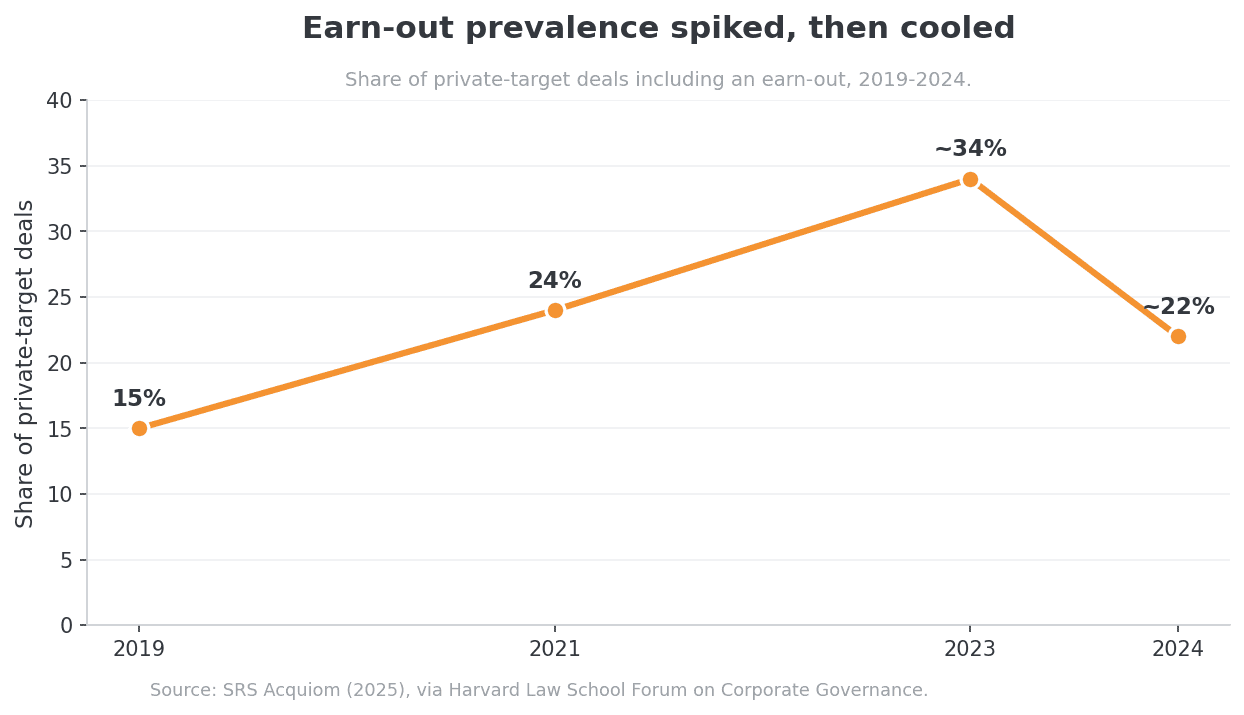
Roughly one in five private-target deals carried an earn-out in 2024, depending on the study you read. SRS Acquiom put usage near 22% of private-target deals, while the ABA’s 2025 Private Target Deal Points Study recorded a decline to about 18% from 26% in its prior survey. Both track the same trend: a sharp pandemic-era spike that has since cooled.
Prevalence isn’t flat over time. Usage sat around 15% in 2019, then surged to roughly 30% to 37% at the 2023 peak when valuation uncertainty was highest. By 2024 it had settled back near 22%, as SRS Acquiom reported (summarized via Harvard Law’s corporate governance forum). Earnouts rise when buyers and sellers can’t agree on price, which is exactly when uncertainty runs high.
Size matters too. The median earn-out equaled 31% of closing payments in 2024 (SRS Acquiom, 2025). By contrast, Seyfarth’s 2024-2025 Middle Market Survey found about 13% of middle-market deals carried earnouts. Of those, roughly half were sized at 50% or more of the price. When the contingent slice is that large, the terms stop being a footnote.
Citation capsule: Roughly one in five private-target deals included an earn-out in 2024, with SRS Acquiom reporting near 22% and the ABA recording about 18%, down from 26%. The median earn-out equaled 31% of closing payments (SRS Acquiom 2025 Deal Terms Study; ABA Private Target Deal Points Study, 2025).
Revenue vs. EBITDA: Which Metric Protects the Seller?
Revenue is the seller-friendlier metric, and the market agrees: 62% of 2024 earnouts used revenue while only 22% used EBITDA, according to SRS Acquiom data summarized by Fasken. The reason is simple. Revenue is one number that’s hard to manipulate. EBITDA is the product of dozens of judgment calls, each one a chance for the buyer to shrink your payout.
So why does the metric choice matter so much? Because EBITDA earnouts invite fights over add-backs, allocated overhead, and management fees the new owner can pile onto “your” results. Push a few corporate costs down into the acquired unit, and EBITDA falls even if the business performed exactly as promised. By contrast, revenue leaves far less room for that kind of accounting gravity.
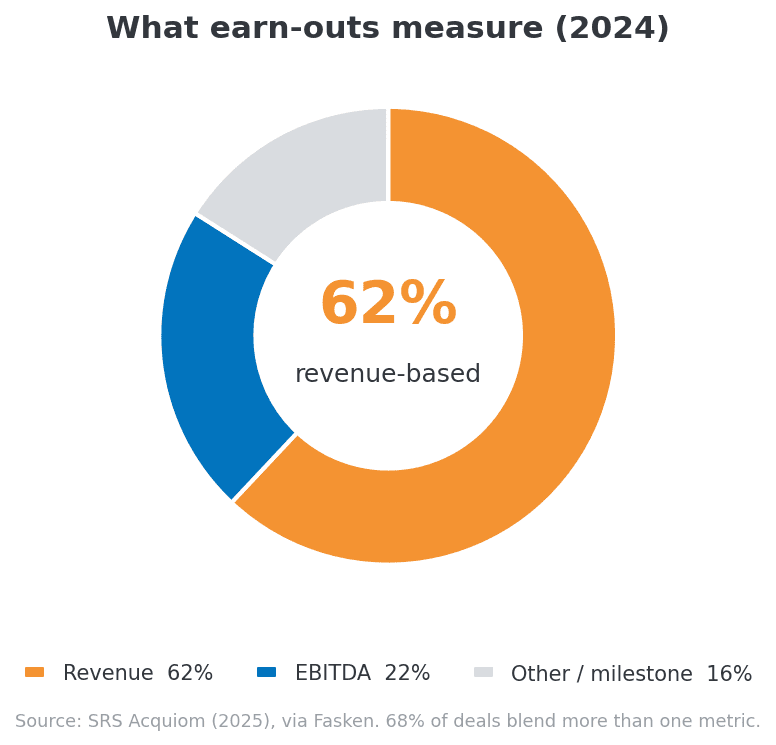
Many deals don’t pick just one. In practice, some 68% of earnout deals use multiple metrics (SRS Acquiom via Fasken, 2025), often pairing a revenue gate with an EBITDA floor. If you can’t avoid EBITDA, then nail down the definition. List every add-back, cap allocated corporate costs, and freeze the accounting methods used at closing. Once those rules are fixed, the buyer can’t change them mid-game.
Citation capsule: Revenue-based earn-outs litigate less than EBITDA-based ones because revenue offers fewer figures to dispute. In 2024, 62% of earn-outs used revenue and only 22% used EBITDA, while 68% of deals blended multiple metrics (SRS Acquiom 2025 data, via Fasken).
The Payout Reality: Do Earn-Outs Actually Pay?
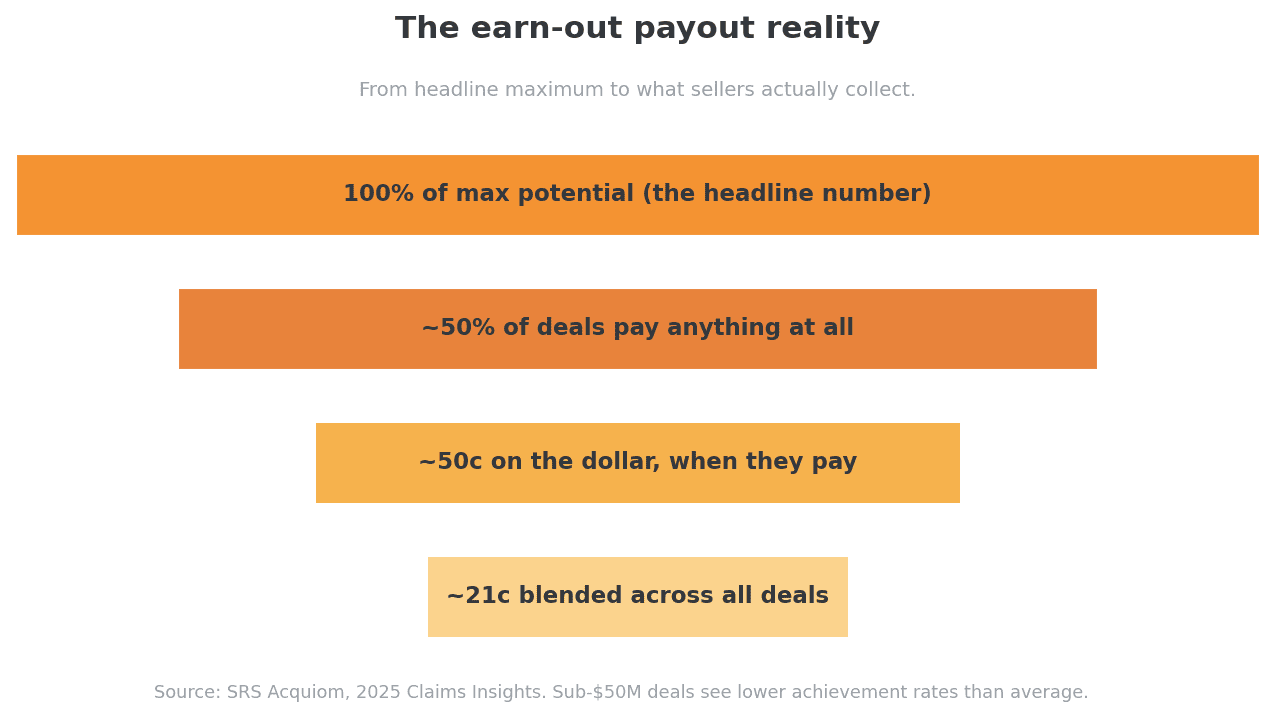
This is the section every seller should read twice. Across all deals, earnouts pay only about 21 cents on the dollar of their stated maximum, per SRS Acquiom’s 2025 Claims Insights analysis. Just over half of earnout deals pay anything at all, and when they do pay, the typical award is around 50 cents of the maximum. The headline number on your term sheet is a ceiling you’ll probably never touch.
So where does the headline number actually go? Walk the funnel down. Start with the full earnout potential the buyer dangles. Only about half of deals clear the bar to pay a single dollar. Among those that do pay, the payout averages roughly half of the maximum. As a result, when you blend the zeros and the partials together, you land near that 21-cent figure across the whole market.
For lower-middle-market sellers, the math is worse, not better. Sub-$50M deals see lower achievement rates than the broader market (SRS Acquiom, 2025), which is exactly the deal size most owners reading this will sign. Smaller companies depend more on the founder, and once the founder leaves or loses control, performance often slips.
None of this means refuse an earnout. It means price the deal on the cash you’re guaranteed, then treat the contingent slice as a lottery ticket whose odds you can improve with good terms. A seller who signs expecting the full number is usually disappointed. A seller who signs expecting the upfront and negotiates hard on protections is usually fine.
Citation capsule: Across all deals, earn-outs pay only about 21 cents on every dollar of their stated maximum, and just over half of earn-out deals pay anything at all. When they do pay, the typical award is roughly 50 cents of the maximum (SRS Acquiom, 2025 Claims Insights).
Seller-Protective Terms to Negotiate
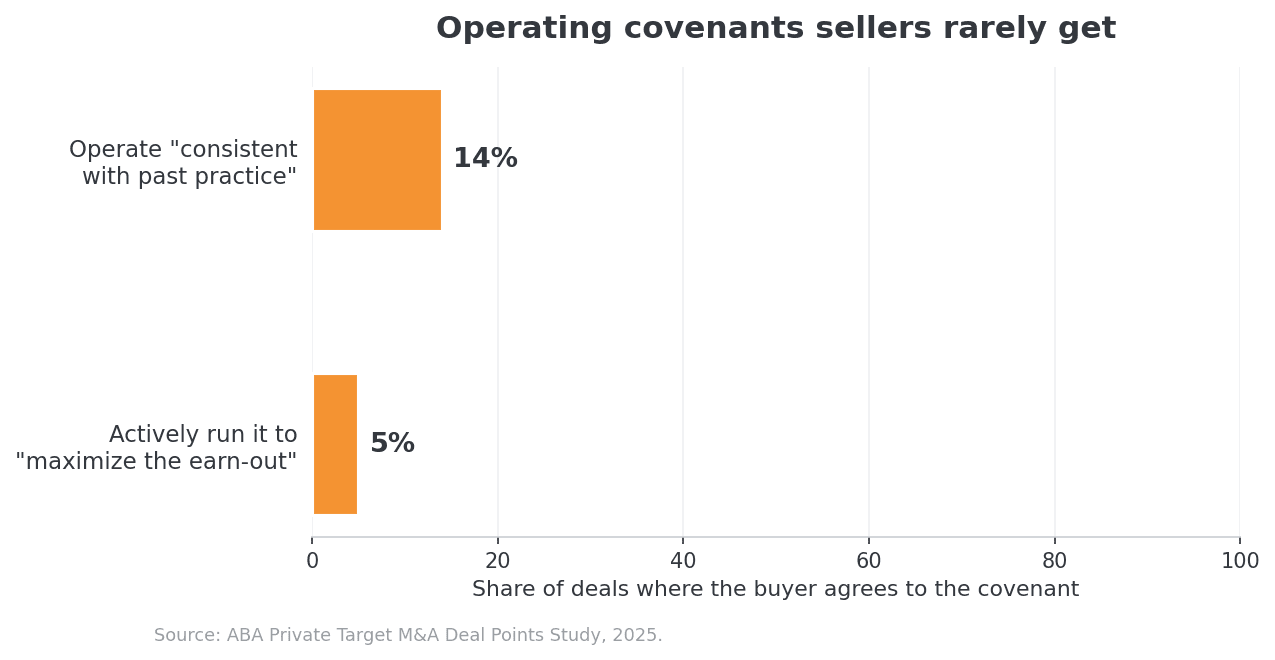
The protections that decide whether your earnout pays are conceded only when sellers demand them, and the data proves how rare that is. Just 14% of buyers agree to operate the business “consistent with past practice,” and a mere 5% agree to actively run it to “maximize the earn-out,” according to the ABA’s 2025 Deal Points Study. The default agreement gives the buyer near-total freedom to run your business however they like.
That gap is the whole game. Without a covenant requiring reasonable operation, the buyer can lawfully make decisions that gut your target: cut the sales team, raise prices, fold your unit into theirs. For example, picture a services firm whose buyer reassigns the top three salespeople to a different division during the earnout window. Bookings stall, the target is missed, and your earnout evaporates. As a result, no one technically breached anything.
Here’s the checklist I push for on the seller’s side of the table.
The Covenant Checklist
- Operate consistent with past practice. The single most valuable covenant. It binds the buyer to run the business the way you did during the measurement period.
- No-frustration / good-faith clause. Bars the buyer from deliberately taking actions designed to suppress the metric.
- Anti-offset language. Stops the buyer from netting indemnification claims against your earnout. Roughly 70% of deals permit indemnity offset by default (SRS Acquiom via TKO Miller), so you have to negotiate it out.
- Change-of-control acceleration. If the buyer sells or merges the business mid-earnout, the unpaid balance accelerates. Only about 23% to 25% of deals include this, so ask.
- Audit and records access. Your right to inspect the books behind the calculation.
- Dispute-resolution mechanism. A named accountant or arbitration path so a fight doesn’t dead-end in litigation.
Notice that almost every item above is something the buyer’s first-draft agreement omits. The standard purchase agreement is written by the buyer’s counsel and protects the buyer. None of these clauses are unreasonable; they’re simply not in the document until your advisor puts them there.
Citation capsule: Buyers concede earn-out operating covenants only when pressed: just 14% agree to operate “consistent with past practice” and only 5% agree to run the business to “maximize the earn-out.” Roughly 70% of deals permit indemnity offset against the earn-out by default (ABA Deal Points Study, 2025; SRS Acquiom via TKO Miller).
What Triggers Earn-Out Disputes (and How to Avoid Them)
Earnouts are contested often, and the litigation is rising. Earn-out disputes arise in roughly 28% of cases, and earn-out court dockets nearly doubled in Q1 2023 versus Q1 2022, according to analysis published through Harvard Law and Bloomberg Law. When more than a quarter of these clauses end in a fight, “we’ll trust each other” is not a structuring plan.
Most disputes trace back to three causes. First, metric ambiguity: the contract never defined exactly how the number is computed, so each side computes it favorably. Second, integration and commingling: the buyer blends your unit into theirs, and the standalone metric becomes impossible to isolate. Third, the EBITDA add-back fight, where the parties war over which costs count.
Avoiding all three is mostly about drafting discipline before closing. Define the metric to the decimal. Require the acquired business to be tracked as a standalone unit during the measurement period. Pre-agree the add-back list. And name your dispute-resolution path so a disagreement routes to an accountant, not a courtroom.
This is the strongest argument for revenue over EBITDA. Revenue litigates less precisely because there’s less to argue about. Every additional judgment call you bake into the metric is another future dispute you’ve pre-purchased.
Citation capsule: Earn-out provisions are contested in roughly 28% of cases, and earn-out litigation dockets nearly doubled in Q1 2023 versus Q1 2022. The leading triggers are metric ambiguity, post-closing integration that commingles results, and EBITDA add-back disputes (Harvard Law / Bloomberg Law, 2025).
How Are Earn-Outs Taxed?
The following is general information, not tax advice. Earn-out taxation is fact-specific and changes with deal structure. Consult your own CPA or tax attorney before you sign anything.
Tax treatment can swing your take-home by a wide margin, and most earn-out explainers skip it entirely. The headline issue: an earnout tied to your continued employment can be taxed as ordinary income at rates up to 37%, plus payroll taxes, rather than at the lower long-term capital-gains rate, according to guidance from Morse Law and GRF CPAs. How the contract characterizes the payment matters enormously.
Structured as purchase price, earnout payments generally qualify for capital-gains treatment. In that case, they can often be reported on the installment method, spreading the gain into the years you actually receive cash. By contrast, structured as compensation for staying on, the same dollars can be taxed as ordinary income with payroll taxes layered on top. Two identical-looking deals, very different after-tax results.
Two more wrinkles to raise with your CPA. First, the installment method has nuances: depreciation recapture and certain assets don’t qualify, so part of the gain may be due upfront. Second, when total deferred payments exceed roughly $5 million, the IRS imputes interest on the deferred portion, converting some of your capital gain into interest income taxed at ordinary rates.
The lesson isn’t a particular rate. It’s that how the earnout is documented drives the tax outcome, and that drafting decision happens during negotiation, when you still have leverage. Bring your CPA in before the purchase agreement is final, not after.
Citation capsule: Earn-out payments tied to continued employment can be taxed as ordinary income up to 37% plus payroll taxes, rather than at capital-gains rates. Deferred payments above roughly $5 million trigger imputed interest taxed at ordinary rates (Morse Law; GRF CPAs, 2024). This is general information, not tax advice.
Earn-Out vs. Seller Note vs. Rollover Equity
An earnout is one of three common ways sellers get “paid over time,” and they carry very different risk profiles. An earnout is performance-contingent and may pay nothing. A seller note is a fixed debt the buyer owes you on a schedule. Rollover equity is an ownership stake you keep in the buyer’s combined company. Knowing which one you’re being offered changes how you negotiate.
The table below compares the three on the dimensions that decide your real risk.
| Feature | Earn-Out | Seller Note | Rollover Equity |
|---|---|---|---|
| What it is | Contingent payment tied to performance | Fixed loan from you to the buyer | Ownership stake in the new company |
| Payment certainty | Low, may pay nothing | High, fixed schedule | Variable, tied to future exit |
| Who controls the outcome | The buyer | Contractual, both bound | The buyer / sponsor |
| Typical tax treatment | Capital gains or ordinary income | Interest (ordinary) + principal | Deferred until the second exit |
| Main seller risk | Missed targets, manipulation | Buyer default | No control, second-bite delay |
| Best when | Buyer and seller disagree on value | Seller wants steady income | Seller believes in the upside |
A seller note sits highest on certainty because it’s a debt obligation, not a bet on results. By contrast, rollover equity offers a “second bite at the apple” if the combined company sells again later. However, you’re a minority owner with little control until that day comes. An earnout sits in between on paper, and often at the bottom in practice, given the 21-cent reality.
When a buyer offers a large earnout, it’s worth asking whether part of it could be restructured as a seller note instead. You trade some upside for certainty, and for many lower-middle-market owners that’s a trade worth making.
Citation capsule: Earn-outs, seller notes, and rollover equity all spread a sale price over time but differ sharply on risk. A seller note is a fixed obligation with high payment certainty, while an earn-out is performance-contingent and, across all deals, pays only about 21 cents on the dollar (SRS Acquiom, 2025).
Ready to Structure or Protect Your Earn-Out?
If a buyer has put an earnout in front of you, the terms you negotiate now decide whether you collect later. At Duran Advisors, we structure upper Main Street and lower middle market deals to protect the seller’s contingent payment, from the metric definition to the operating covenants. Book a consultation and we’ll walk through your specific offer.
Frequently Asked Questions
How does an earn-out work?
An earn-out pays you an upfront sum at closing, then a contingent amount if the business hits agreed targets over a measurement period. The median period runs 24 months, and 81% of earn-outs last longer than a year (SRS Acquiom via TKO Miller). You collect the contingent slice only if the metric clears its threshold.
What percentage of M&A deals have earn-outs?
Roughly one in five private-target deals, depending on the study. SRS Acquiom reported usage near 22% in 2024, while the ABA’s 2025 Deal Points Study recorded about 18%, down from 26% in its prior survey. Usage peaked around 30% to 37% in 2023 before cooling (SRS Acquiom, 2025; ABA, 2025).
How are earn-outs taxed?
It depends on how the payment is characterized, and this is general information, not tax advice. Earn-outs treated as purchase price generally qualify for capital-gains treatment, while those tied to continued employment can be taxed as ordinary income up to 37% plus payroll taxes (Morse Law, 2024). Consult your CPA before signing.
What is the average earn-out period?
The median earn-out measurement period is 24 months, and 81% of earn-outs run longer than one year, according to SRS Acquiom data summarized by TKO Miller. Periods of one to three years are most common. A longer window increases the odds that integration or a leadership change disrupts your targets.
Do earn-outs actually pay out?
Often not in full. Across all deals, earn-outs pay only about 21 cents on the dollar of their stated maximum, and just over half pay anything at all (SRS Acquiom, 2025 Claims Insights). When they do pay, the typical award is roughly 50 cents of the maximum. Sub-$50M deals see lower achievement rates.
Is revenue or EBITDA the better earn-out metric for a seller?
Revenue is generally safer for the seller because it offers fewer figures to dispute and is harder for the buyer to manipulate. In 2024, 62% of earn-outs used revenue versus 22% for EBITDA (SRS Acquiom via Fasken). EBITDA invites fights over add-backs and allocated costs that can shrink your payout.
About the Author
Joel Duran (M&AMI, CM&AA) has spent 15 years structuring upper Main Street and lower middle market M&A transactions, with a focus on protecting sellers through deal terms that hold up after closing.
Sources
- SRS Acquiom, 2025 Claims Insights, “M&A Claims: Undisclosed Liabilities & Earnouts.” https://www.srsacquiom.com/our-insights/ma-claims-undisclosed-liabilities-earnouts/
- SRS Acquiom, M&A Earnouts Overview. https://www.srsacquiom.com/our-insights/ma-earnouts-overview/
- Harvard Law School Forum on Corporate Governance, “The Art and Science of Earn-Outs in M&A,” 2025. https://corpgov.law.harvard.edu/2025/07/11/the-art-and-science-of-earn-outs-in-ma/
- American Bar Association, 2025 Private Target Mergers & Acquisitions Deal Points Study. https://businesslawtoday.org/2025/12/announcing-aba-2025-private-target-mergers-acquisitions-deal-points-study/
- Seyfarth, 2024/2025 Middle Market M&A Survey. https://www.seyfarth.com/news-insights/seyfarth-releases-20242025-middle-market-manda-survey.html
- Fasken, “Key Takeaways from SRS Acquiom’s 2024 M&A Deal Terms Study,” 2025. https://www.fasken.com/en/knowledge/2025/03/key-takeaways-from-srs-acquioms-2024-ma-deal
- TKO Miller, “The Enduring Earnout in Middle-Market M&A.” https://www.tkomiller.com/blog/the-enduring-earnout-in-middle-market-ma
- Morse Law, “Taxation of Earnout Payments in M&A Transactions.” https://www.morse.law/news/taxation-of-earnout-payments-in-ma-transactions/
Joel F. Duran has 15+ years of M&A and business brokerage experience and holds the CM&AA, M&AMI, CM&AP, CEPA, CVGA, CVB, CAIM, and CMSBB designations. Duran Advisors serves upper Main Street and lower middle market businesses across the Gulf South, including New Orleans Metro, the North Shore, Baton Rouge, Houma-Thibodaux, and South Mississippi.