
TL;DR: A good exit is not an event, it is a process. The Value Acceleration Methodology runs that process in three stages: discover where you stand, prepare and grow the value, then make a conscious decision to execute a sale plan. Spread across 36 months, those three stages become a concrete, prioritized timeline. Most owners skip the first two stages and pay for it at the closing table.
Here is the uncomfortable truth most owners learn too late. Your company is probably worth more than your balance sheet shows, and that hidden value is exactly the part you can lose if you wait until you feel “ready” to sell. The Exit Planning Institute, whose Value Acceleration training I completed, estimates that only about one in five owners ever harvests the wealth trapped in their business, and close to half exit on someone else’s timeline because of a health event, a partner dispute, or a downturn.
The fix is not to sell faster. It is to run a process that starts years before a buyer ever appears. This guide walks through that process, the methodology behind it, and the 36-month timeline that puts it on a clock.
Key Takeaways – The Value Acceleration Methodology has three stages: Discover, Prepare, and Decide. – Around 80% of a private company’s value is intangible, the part most owners never measure (Exit Planning Institute). – The 36-month plan is that methodology on a timeline: one stage to discover, a long stage to prepare, and a final stage to decide and execute. – It begins with a Triggering Event: a valuation plus a personal and financial assessment that becomes your prioritized action plan.
What is the Value Acceleration Methodology?
The Value Acceleration Methodology is the framework we build every exit plan on, and it comes down to one simple idea: you cannot decide to sell well until you know where you stand and have done the work to be ready. It organizes the entire journey into three stages, Discover, Prepare, and Decide.
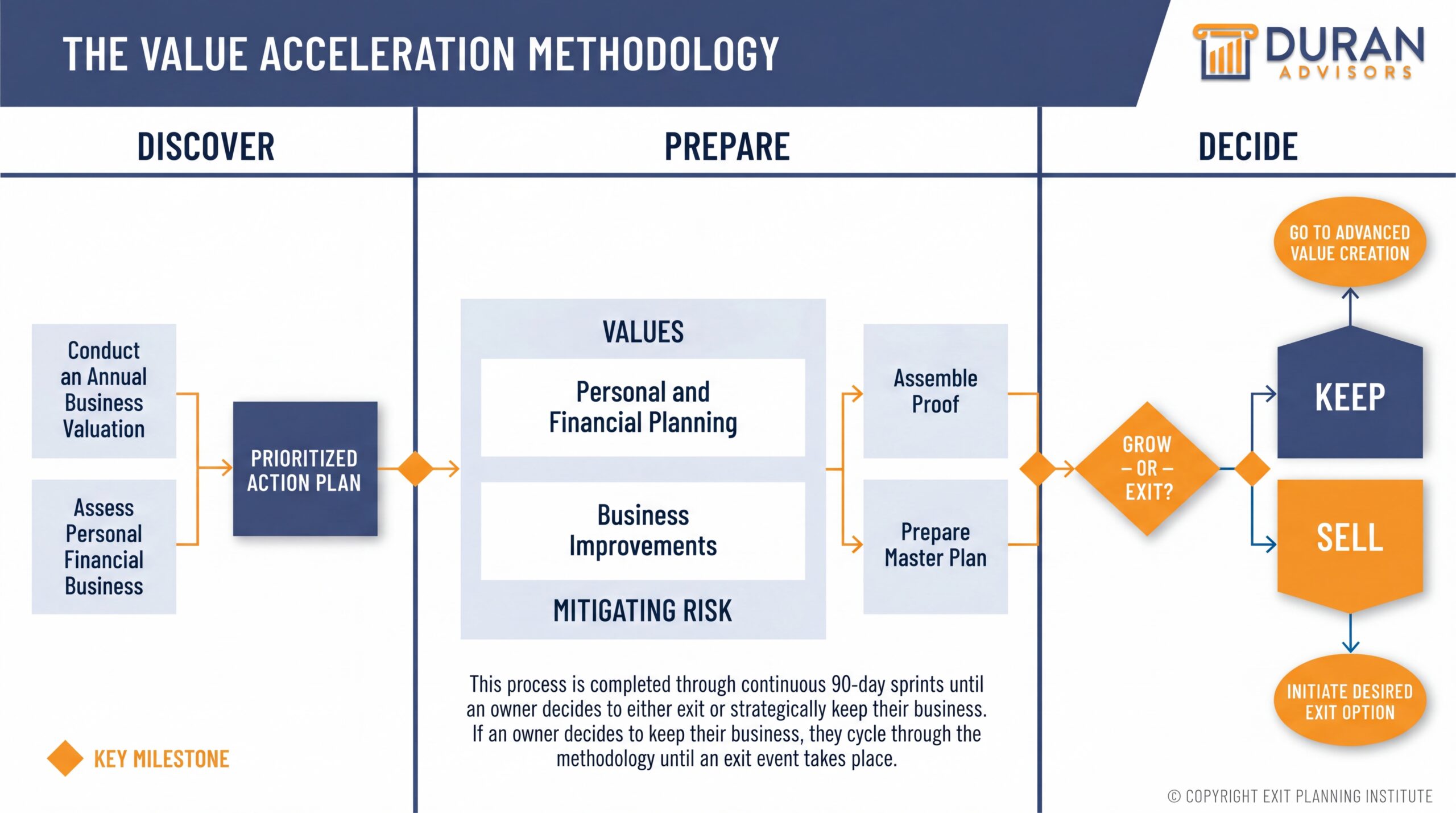
Discover is about knowing where you stand. You get a business valuation, assess your personal and financial readiness, and combine the two into a prioritized action plan. This is the baseline. You cannot close a gap you have never measured.
Prepare is about doing the work. This is where you mitigate risk and grow value, what the methodology calls value acceleration. You strengthen the business, assemble the proof a buyer will demand, and run it as a continuous loop of 90-day sprints. It is the longest stage by far, because real value growth compounds over time.
Decide is the conscious choice. Once the business is genuinely ready, you reach a fork: grow or exit. You either strategically keep the business and keep accelerating its value, or you execute a sale plan and initiate the exit on your terms. The point is that the decision is deliberate, made from a position of strength, not forced by an event or a tired owner.
The methodology is built to be repeated. An owner can cycle through Discover and Prepare many times, raising value with each loop, until they decide the moment is right. The 36-month exit plan below is simply this methodology placed on a timeline.
Citation capsule: The Value Acceleration Methodology organizes an exit into three stages: Discover (a valuation plus a personal and financial assessment that becomes a prioritized action plan), Prepare (mitigating risk and growing value through continuous 90-day sprints while assembling proof), and Decide (the deliberate choice to grow or exit). It is designed to repeat until the owner chooses to execute a sale (Exit Planning Institute).
The 36-month exit plan at a glance
Put the three stages on a calendar and they become a concrete timeline. The 36-month exit plan spends the first stage discovering your position, the long middle stage preparing and accelerating value, and the final months deciding and executing the sale.

Read it from left to right, counting down to your target close date:
- Month 36, Discover. A business valuation and assessment plus a personal financial plan combine into a single prioritized action plan that guides everything after it.
- Months 35 to 6, Prepare. You execute that plan through continuous 90-day sprints: mitigating risk, accelerating value, and assembling the proof a buyer will demand. This is roughly 29 months, on purpose.
- Months 6 to 0, Decide. You take the business to market, then work the deal to a close.
Notice the shape. The preparation stage dwarfs the rest, because that is where the price is actually set. The market-and-close window at the end is short. Once a business does go to market, the median deal still takes about 170 days to close (BizBuySell, 2025). Everything that determines the number at that closing happened in the months before it.
Why start 36 months out?
Start three years out because the moves that lift your price take that long to show up. Reducing owner dependency, diversifying customers, and documenting how the business runs are the changes a buyer pays a premium for, and they take 18 to 24 months to register in your numbers. With around 80 to 90% of a typical owner’s net worth tied up in the business (Exit Planning Institute), the runway is not a luxury. It is how you protect the bulk of your wealth.
There is a principle from the training that reframes the whole question: if you are not ready to sell, you are not ready to grow. The same things that make a business attractive to a buyer make it stronger to own. So the 36-month plan is not 36 months of waiting. It is 36 months of building a more valuable, less risky company, with a sale as the option at the end rather than the only goal.
There is also a defensive reason to start early. With roughly 73% of private companies planning a transition within the decade and close to $14 trillion in value set to change hands (Project Equity, 2023), a wave of supply is coming. When many sellers hit the market at once, the prepared ones command terms and the rest compete on price.
Discover: run your Triggering Event
The Discover stage is a single, high-value piece of work the methodology calls a Triggering Event: a business valuation paired with a personal and financial assessment, correlated to the company’s range of value. It is the most useful day an owner can spend, because it converts a vague worry (“am I going to be okay?”) into specific numbers. Only about 60% of owners have had a formal valuation in the prior two years (Project Equity, 2023), so most enter their exit blind to the number that governs it.
The Triggering Event reveals your three gaps:
- The value gap is the distance between what the business is worth today and what a best-in-class version of it would be worth.
- The wealth gap is the distance between the assets you hold outside the business and the number you need to fund the life you want. A common shortcut is to divide your target annual income by 4%.
- The profit gap is the distance between your current profitability and what best-in-class operators in your industry produce on the same revenue.
It also reframes a number you think you already know. Your real number is not your tax number. Valuation runs on the real number, the one that appears after you add back owner-specific and one-time items, and it is frequently a revelation.
Combine the business valuation with the personal and financial plan and you get the deliverable that drives the next two and a half years: a prioritized action plan.
Many of our business valuations are referred to us by financial planners who use the exit planning methodology. They’re putting together a financial plan for a business owner and want to understand what is typically the value of what is typically their greatest asset, the business. If these owners are planning an exit, we will typically work with them to oversee that exit plan. As an example, if they are several years out from a sale, we can give them a roadmap over that 36 months to 4x the value of the company, typically.
These types of engagements are great for business owners because they are able to touch base with us every 90 days, go over what is going to impact value the most as well as their quality of life in the business. It allows us to get involved early and shore up the company that we will eventually be selling. Business owners love it because they are able to get immediate feedback during the entirety of their Value Improvement Program.
Duran provides two complimentary valuation updates on any valuation performed for exit-planning purposes, so you can watch the value gap close across the 36 months instead of guessing.
Citation capsule: The Discover stage runs a Triggering Event: a business valuation plus a personal and financial assessment, correlated to the range of value (Exit Planning Institute). It reveals the value gap, the wealth gap, and the profit gap, and separates the owner’s “tax number” from the “real number” a buyer values. Combined, the valuation and the personal plan become a prioritized action plan for the rest of the timeline.
Prepare: mitigate risk and accelerate value
Prepare is the heart of the plan and the reason the runway has to be long. You work the prioritized action plan through continuous 90-day sprints, mitigating risk and growing value, while assembling the proof a buyer will demand. Three workstreams run through this stage.
Reduce owner dependency and grow value
The lever that moves your value most is the part you cannot see on a balance sheet. Roughly 80% of a private company’s worth is intangible capital (Exit Planning Institute), and most owners never measure it.

The methodology breaks that intangible value into four kinds of capital:
- Human capital: your people, their tenure, cross-training, documented roles, and a real succession bench.
- Structural capital: the processes and systems that let the business run without heroics.
- Customer capital: diversified, loyal, ideally contracted customer relationships.
- Social capital: the culture that holds the other three together.
Reducing owner dependency is the single highest-leverage move inside those four. If the business cannot run for 90 days without you, a buyer sees risk, not value. A buyer’s price tracks how attractive and how ready the business is, and a business that scores poorly on readiness gets a steep discount no matter how good the story sounds. So document the processes, push decisions down, and build a management layer that operates without you. This is the work Duran anchors with a CVGA (Certified Valuation Growth Advisor) approach that targets the value drivers systematically rather than hoping the multiple lifts on its own.
Assemble proof: recast the financials and build the data room
A buyer will not take your word for it, so Prepare is also where you build the evidence. Recasting adjusts your financials to show true earning power by removing owner-specific and one-time items, documenting the real number to a standard a buyer’s accountants can verify. Then you build a data room, the organized repository of every document diligence will request: three years of financials and tax returns, customer and supplier contracts, leases, employee records, and corporate documents. Up to half of M&A deals fail to close, with many lower-middle-market deals dying in diligence over financial surprises (NINBB, 2025). Clean books are the cheapest insurance against landing in that half.
Build your coordinated advisor team
No single advisor carries a clean exit. EPI research shows 78% of owners had no transition team in place (Project Equity, 2023). Assemble four seats during Prepare: an M&A advisor to quarterback the deal, a CPA to structure it for the best after-tax outcome, a transaction attorney to protect you in diligence, and a financial planner to confirm the proceeds fund your life. The word that matters is coordinated. A quarterbacked team closes deals a scattered one loses, which is why Coordinated Advisor Collaboration is one of Duran’s three differentiators, alongside Regional Market Expertise and an Education-Driven Approach.
Citation capsule: The Prepare stage mitigates risk and grows value through continuous 90-day sprints. Around 80% of a company’s value is intangible capital across four areas, human, structural, customer, and social (Exit Planning Institute), and reducing owner dependency is the highest-leverage move within them. Owners also assemble proof through recast financials and a data room, and build a coordinated advisor team, because 78% of owners reach their exit with no team in place (Project Equity, 2023).
Decide: take it to market and work the deal
By Month 6 the business is ready, and Decide is where you execute. The first move is taking it to market the right way. Confidentiality comes first, because a leaked process can spook your employees, customers, and suppliers before you have a buyer. A disciplined process protects you with a blind teaser, a non-disclosure agreement before details change hands, and controlled release of information only to qualified buyers.
The buyer pool is where regional knowledge earns its keep. In the Gulf South lower middle market, the right buyer is often a regional strategic acquirer or a local financial buyer, not the first national name to call. Regional Market Expertise, the first of Duran’s three differentiators, means knowing who is actually acquiring within roughly 200 miles of New Orleans and what they will pay. That is the basis of the Duran system promise: you will know what the market thinks in under 30 days.
Then you work the deal. A letter of intent, or LOI, is the buyer’s proposed terms: price, structure, and the exclusivity window during which you stop talking to other buyers. A well-negotiated LOI protects your price and leverage; a rushed one hands both to the buyer. Watch for a pattern I see often: a private equity buyer reaches out directly, moves fast to a non-binding LOI, locks the owner into exclusivity, then grinds the price down in diligence once the seller has no other options. Roughly a turn of EBITDA can disappear that way. The defense is the preparation you already did. Clean financials remove the diligence ammunition, and a competitive buyer pool means you are never the captive seller with nowhere else to go. If your data room is ready and your numbers are recast, diligence becomes a confirmation exercise instead of an opening to re-trade.
Decide is also where the methodology’s real choice lives. Ready does not have to mean sell. Some owners reach this fork, see what the business is now worth, and choose to keep it and keep accelerating value through another cycle. The point of the entire process is that the decision is yours, made from strength.
Citation capsule: The Decide stage executes the sale: a confidential market process that engages a qualified regional buyer pool, then a well-negotiated letter of intent and a diligence process that a pre-built data room turns into a confirmation exercise. Up to half of M&A transactions fail to close, with lower-middle-market deals especially likely to die in diligence (NINBB, 2025), so the deals that survive are the ones that did the Prepare work first.
Plan the life after the sale
The personal leg of Discover is the one owners neglect, and it is the one that drives regret. In the training, the most common profile was an owner with a strong business but no personal plan and a spouse who was barely involved. One owner in a case study, pressed on what he would do after the sale, admitted: “I’m a personal mess. I don’t know what I want to do.” The instructor’s response stuck with me. Maybe the business is not what is holding you back. Maybe it is the excuse you use not to leave.
That is why the personal plan sits inside Discover at Month 36, not bolted on at the end. When 80 to 90% of your net worth and most of your identity convert to cash in a single event, “what now?” is not a soft question. It is the question. Define what you are retiring to, confirm the after-tax proceeds actually fund it, and give yourself time to grow into the shift. The stakes are real: in a 2025 national study, 49% of owners said their retirement is at risk if they cannot sell, and 48% of boomer owners said they want out within three years (Cornerstone, 2025).
Exit planning vs. succession planning
Exit planning prepares the business, your finances, and your life for any way you leave. Succession planning is the narrower piece that names and develops who takes over. Only 34% of family businesses have a documented succession plan (PwC, 2025). Succession planning assumes the business stays in the family or the team. Exit planning stays neutral on the destination, which is why it fits the Value Acceleration Methodology: it works whether you sell to a strategic buyer, a private equity group, a key employee, or your kids. Most lower-middle-market owners think they are succession planning, but their most likely buyer is external, so they need the broader plan.
FAQ
What is the Value Acceleration Methodology?
It is a three-stage framework for exiting a business well: Discover, Prepare, and Decide. Discover means knowing where you stand through a valuation and a personal and financial assessment. Prepare means mitigating risk and growing value through continuous 90-day sprints while assembling proof. Decide means making a deliberate choice to either keep growing the business or execute a sale plan. It is built to repeat until the owner chooses to exit.
How many years before selling should I start exit planning?
Start about 36 months out. The changes that lift your price, mainly reducing owner dependency and strengthening the value drivers, take 18 to 24 months to show up in your numbers. Starting early also protects you, because close to half of exits are forced by a health event, partner dispute, or downturn rather than chosen. Even if you think you have five years, begin now.
What is a Triggering Event in exit planning?
A Triggering Event is the first stage of the methodology: a business valuation paired with a personal and financial assessment, correlated to your range of value (Exit Planning Institute). It reveals your value gap, wealth gap, and profit gap, separates your tax number from the real number a buyer values, and combines into a prioritized action plan for the rest of the timeline.
What makes a business more attractive to buyers?
Buyers pay premiums for businesses that do not depend on the owner, have diversified customers, show clean and defensible financials, and offer a growth story the buyer can continue. A buyer’s price tracks how attractive and how ready the business is. Around 80% of that value is intangible capital, so the work is measuring and strengthening it, which is why the Prepare stage takes the most time.
How long does it take to sell a business?
Once a business goes to market, the median deal takes about 170 days to close (BizBuySell, 2025). That is only the Decide stage. A well-run exit includes 24 to 36 months of Discover and Prepare work beforehand, where the value is actually built.
Conclusion: start the clock at 36 months
Your price is set by the work you do before a buyer ever appears, and that work follows a process: discover where you stand, prepare and grow the value, then decide and execute. Most owners never unlock the wealth inside their business, not because the business is weak, but because they ran out of runway to prepare it and themselves.
The lowest-friction first step is the Discover stage: a defensible valuation and a personal financial assessment that become your prioritized action plan. Duran provides two complimentary valuation updates on any valuation performed for exit-planning purposes, so you can watch your value gap close across the 36 months. When you are ready to start the clock, book a consultation.
Joel F. Duran has 15+ years of M&A and business brokerage experience and holds the CM&AA, M&AMI, CM&AP, CEPA, CVGA, CVB, CAIM, and CMSBB designations. Duran Advisors serves upper Main Street and lower middle market businesses across the Gulf South, including New Orleans Metro, the North Shore, Baton Rouge, Houma-Thibodaux, and South Mississippi. Examples in this article are composites and do not reference any specific client.
Continue Learning
- Business Valuation: The Complete Owner’s Guide
- How Long Does It Take to Sell a Business?
- Recasting Financial Statements
- What is a Letter of Intent? A Seller’s Guide
- What is Value Acceleration?
- Duran valuation services
- Our Exit Planning Process
Sources
- Exit Planning Institute, Value Acceleration Methodology training (attended 2024); methodology graphic licensed from the Exit Planning Institute. https://exit-planning-institute.org/
- Exit Planning Institute, State of Owner Readiness (2023). https://exit-planning-institute.org/state-of-owner-readiness
- Project Equity, Business Owner Statistics & Exit Planning (EPI stats roundup, 2023). https://project-equity.org/news/employee-ownership-insider/business-owner-statistics-exit-planning/
- Cornerstone, 2025 National Study (2025). https://www.cornerstone-business.com/the-silver-tsunami-is-here-48-of-boomers-want-out-in-3-years/
- BizBuySell, Q3 2025 Insight Report (2025). https://www.bizbuysell.com/news/bizbuysell-2025-third-quarter-insight-report/
- PwC, US Family Business Survey / Business Transition & Succession Planning (2025). https://www.pwc.com/us/en/services/audit-assurance/private-company-services/family-business/business-transition-and-succession-planning.html
- NINBB, The Due Diligence Trap: Why Lower-Middle-Market Deals Fall Apart (2025). https://www.ninbb.com/blog/the-due-diligence-trap-why-lower-middle-market-deals-fall-apart