
If you own a business and you are starting to think about selling, the first question is almost always the same. How long is this going to take? You have heard stories of deals that closed in 90 days and stories of listings that sat for two years and never sold. Both are true, and the difference between them is rarely luck.
The honest answer is that a well run lower middle market sale usually takes six to twelve months from the day you go to market to the day you close, and the preparation that comes before that can add anywhere from a few months to a few years if you want full value. Below is a realistic, stage by stage breakdown so you can plan around your own situation rather than around someone else’s war story.
TL;DR: Most lower middle market businesses take roughly 6 to 12 months to sell from go to market to close, and longer once you count preparation. Recent BizBuySell data put the median time to close at about 170 days in 2025, with deals reaching market in a median of 149 days in Q3 2025. Due diligence is usually the slowest paid stage at 30 to 90 days. Prepared, fairly priced sellers close faster and more often. Roughly 31 percent of advisor engagements end without a sale (Pepperdine 2025), so readiness matters as much as time.
I have spent 15 years advising lower middle market owners across the Gulf South, and the question of timing comes up in nearly every first conversation. Owners want a date they can plan around, because family plans, tax years, and partner buyouts all run on calendars, so a vague “it depends” is not useful. What I can give you instead is a framework. A sale is a sequence of stages, each with its own typical duration, and when you understand where the time actually goes, you can see which parts you control and which parts the market controls.
Key Takeaways – Plan on 6 to 12 months from go to market to close for a typical lower middle market business, plus preparation time before that. – The median small business reached a sale in 149 days in Q3 2025 and the median time to close held near 170 days for the full year (BizBuySell, 2025). – Due diligence is usually the longest paid stage, commonly 30 to 90 days, and it stretches when financials are not clean. – Pricing realism, clean books, low owner dependency, and ready financing are the biggest levers on speed. – About 31 percent of advisor engagements end without a transaction (Pepperdine, 2025), so “how long” depends heavily on how prepared you are.
How long does it take to sell a business?
Most lower middle market businesses take about 6 to 12 months to sell, measured from the day the business goes to market to the day the deal closes. Add preparation time and the full journey often runs longer. Recent national data backs this up. BizBuySell reported a median time to close near 170 days for 2025, and businesses reached a sale in a median of 149 days in the third quarter, the fastest pace since 2017.
It helps to separate two clocks. The first is time on the market, which is how long it takes to find a serious buyer and reach an agreement. The second is time from agreement to close, which covers due diligence, financing, and legal work. A deal can find a buyer quickly and then spend three months in diligence, or it can sit on the market for eight months and then close in six weeks. The total is what owners feel, and the total is what we plan around.
One more honest point up front. Not every business that goes to market sells. According to the Pepperdine Private Capital Markets Report, roughly 31 percent of advisor engagements ended without a completed transaction in 2025, most often because of a valuation gap. So “how long does it take to sell a business” is partly a question about readiness. A prepared, fairly priced business sells on a predictable timeline. An overpriced or unprepared one can sit indefinitely.
Citation capsule: The median time to close was approximately 170 days for full-year 2025, with a median of 149 days on market in Q3 2025, the fastest since 2017 (BizBuySell Insight Report, 2025).
The business sale timeline, stage by stage
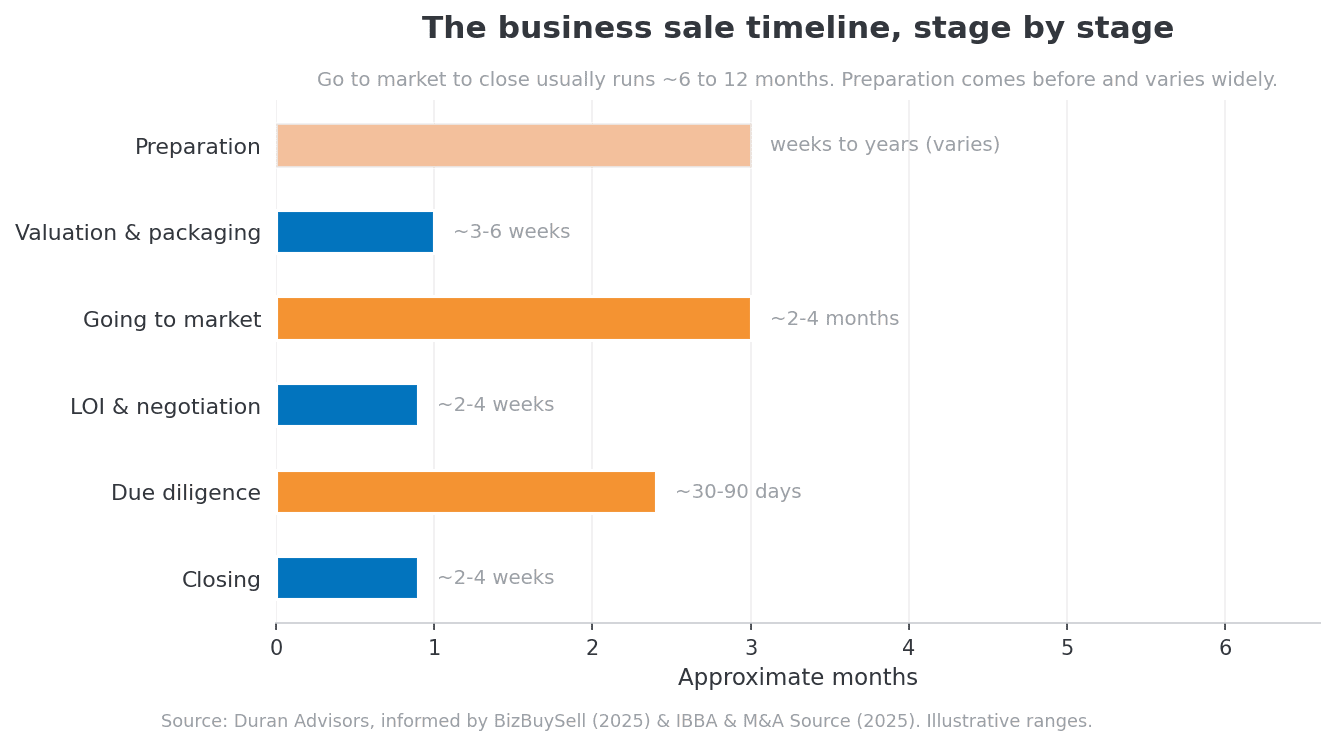
A business sale moves through six stages: preparation, valuation and packaging, going to market, the letter of intent and negotiation, due diligence, and closing. Preparation is often the longest stage and the most variable, while due diligence is usually the longest paid stage once a buyer is committed. Here is what each stage involves and how long it typically runs.
Preparation, or getting sale ready. This is the work of cleaning up financials, reducing owner dependency, documenting processes, and resolving anything a buyer would flag. It can take a few weeks if your house is already in order, or one to three years if you are pursuing a full value acceleration plan. Our guide on how to prepare your business for sale walks through the specifics, and the 36-month exit plan shows what a longer runway looks like.
Valuation and packaging. Establishing a defensible value and building the marketing materials, the teaser and the confidential information memorandum, typically takes a few weeks. If you want to understand how value is set, our complete owner’s guide to business valuation covers the methods.
Going to market and finding a buyer. This stage varies the most. A well positioned, fairly priced business in an active sector can attract real interest in weeks. A niche or richly priced business can take many months. This is the stage the market controls.
Letter of intent and negotiation. Once a buyer is serious, negotiating and signing a letter of intent usually takes a few weeks. The LOI sets price, structure, and the diligence period. Our seller’s guide to the letter of intent explains what to watch for.
Due diligence. The buyer verifies everything. This is typically 30 to 90 days and is usually the slowest paid stage. More on this below.
Closing. Final legal documents, financing, and funding usually take a few weeks. If the deal includes an earn-out, part of your proceeds will be tied to future performance, which extends your involvement past the closing date even though the sale itself is done.
| Stage | Typical duration | What happens |
|---|---|---|
| Preparation | Weeks to 1 to 3 years | Clean financials, reduce owner dependency, document processes, fix value gaps. |
| Valuation and packaging | About 3 to 6 weeks | Set a defensible value, build the teaser and confidential information memorandum. |
| Going to market | About 2 to 4 months (varies widely) | Reach qualified buyers, field interest, secure indications of value. |
| LOI and negotiation | About 2 to 4 weeks | Negotiate and sign the letter of intent setting price, structure, and terms. |
| Due diligence | About 30 to 90 days | Buyer verifies financials, legal, operations, customers, and contracts. |
| Closing | About 2 to 4 weeks | Final legal documents, financing, and funding. |
Citation capsule: Due diligence in the $5 million to $10 million segment averaged a record 5.5 months in 2025, while smaller Main Street deals move faster (IBBA & M&A Source Market Pulse, 2025).
How long does due diligence take?
Due diligence typically takes 30 to 90 days for a lower middle market deal, and it is the stage most likely to stretch. During diligence the buyer and their advisors verify your financials, contracts, customer concentration, employee matters, and legal standing. The cleaner your records, the faster this moves. Messy books or surprises are the most common reason a deal slows down or falls apart here.
Larger and more complex deals take longer. IBBA & M&A Source data indicated that due diligence in the $5 million to $10 million range averaged about 5.5 months in 2025, a record high, while smaller Main Street transactions move through diligence faster. The lesson is consistent. The more an outside party has to untangle, the longer the verification takes.
Financing timing lives inside this window too. Many small business acquisitions are funded with an SBA 7(a) loan, and that process commonly adds 30 to 90 days from accepted offer to funding depending on the lender. Experienced, preferred lenders move faster. If your buyer needs financing, build that into your expectations.
Citation capsule: SBA 7(a) acquisition financing commonly takes 30 to 90 days from offer to funding, with preferred lenders moving faster (SBA.gov program guidance and lender data, 2025).
What makes a business sell faster or slower?
The biggest drivers of speed are pricing realism, the quality of your financials, the size of the business, owner dependency, the industry, buyer financing, and deal structure. Each one can shave months off your timeline or add them. Here is how they work in practice.
Pricing realism. The single most common reason deals stall is a valuation gap between what the seller wants and what the market will pay. Pepperdine’s 2025 data lists the valuation gap as the top reason engagements end without a sale. A fairly priced business sells. An aspirational price invites long silence.
Clean financials. Buyers and lenders move at the speed of your records. Tax returns that reconcile, clear add-backs, and tidy monthly statements speed up both marketing and diligence. Messy books slow everything.
Business size. Smaller Main Street businesses tend to move through the process faster, while larger lower middle market deals carry more diligence and more complex financing, which extends the timeline.
Owner dependency. If the business cannot run without you, buyers see risk and underwrite slowly. A capable management team that can operate without the owner shortens diligence and widens the buyer pool.
Industry and buyer financing. Active, in demand sectors attract buyers quickly. Deals that depend on SBA or bank financing inherit those lenders’ timelines. All cash or strategic buyers can move faster.
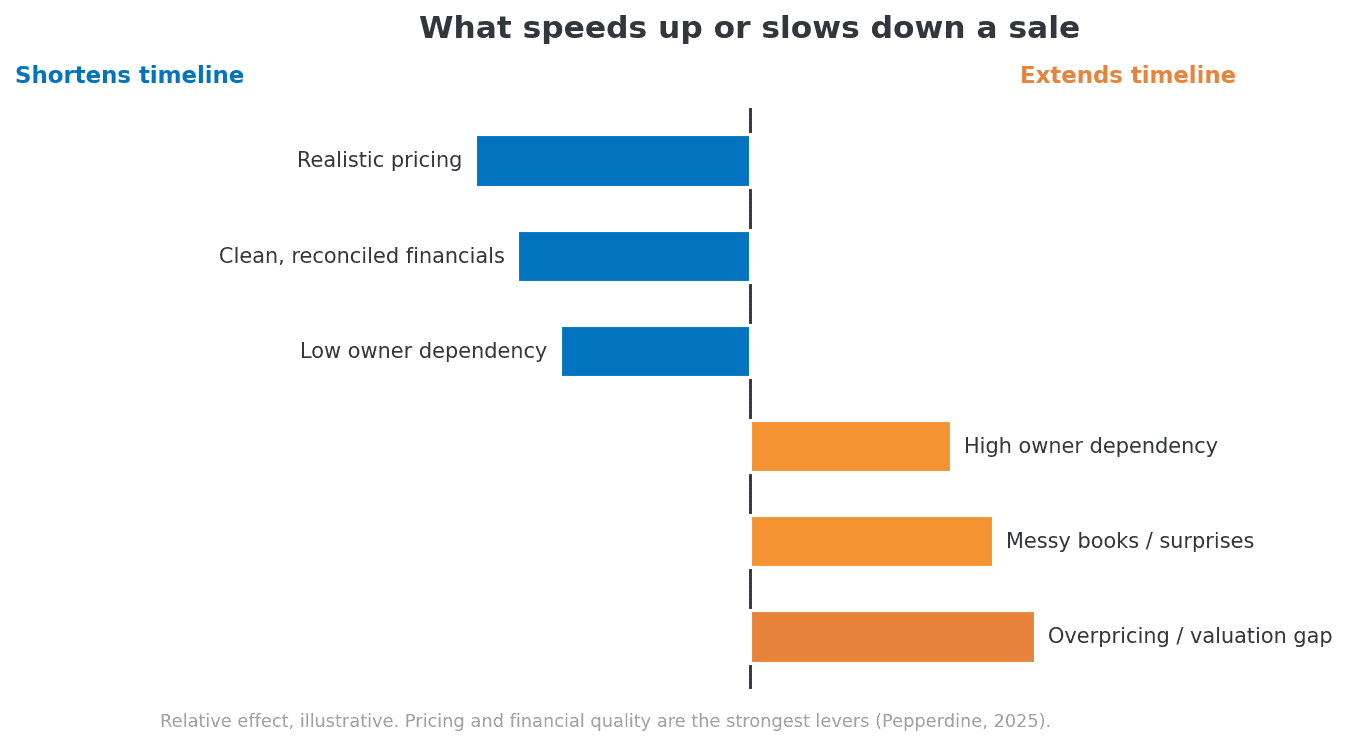
Citation capsule: The valuation gap was the leading reason advisor engagements ended without a sale, and roughly 31 percent of engagements closed with no transaction (Pepperdine Private Capital Markets Report, 2025).
Why preparation is the biggest lever on speed and price
Prepared sellers sell faster and for more because preparation removes the friction that slows or kills deals. Every hour you spend cleaning financials, reducing owner dependency, and documenting how the business runs is an hour a buyer does not spend uncovering surprises. Preparation shortens marketing, shortens diligence, and protects your price.
Think of it as front loading the work. You can do the cleanup before you go to market, on your own schedule and with no buyer watching, or you can let it surface during diligence when every problem becomes a negotiating lever against you. The first path is calm and shorter. The second is stressful and often costs you both time and dollars.
I tell every client the same thing: when we prepare for a sale, our objective is to do everything we can to create buyer confidence. The simplest, most powerful move is to itemize the accounts, from the recasting down to the penny, straight from the general ledger. It is far more work on the front end. But I have watched it pay off time and again. A buyer reviews the financials, asks a few questions, sees that what we represented is precise and accurate, and then moves on without a deep dive.
Rushing to market with incomplete information does the opposite. It costs you money in the form of a risk-adjusted price, and it costs you the best buyers. To a serious buyer, incomplete information signals that the owner is not really prepared to sell, and therefore probably not serious. Precision early is what keeps a high-quality buyer at the table.
This is also why the prepared business sells at all. With about 31 percent of engagements ending without a transaction, the gap between a business that sells in eight months and one that never sells is usually readiness and price, not the calendar. If you are early, our preparation guide and the 36-month exit plan show how to use a longer runway to lift both speed and value.
How long until you know what the market thinks?
You should not have to wait six months to learn whether your price and positioning are realistic. With a focused process, you can have credible market feedback in under 30 days. This is feedback, not a closed deal. It means real buyers have seen the opportunity and responded with genuine indications of interest and value, which tells you quickly whether you are positioned right.
This matters because the most expensive mistake in a sale is spending months chasing a price the market will not support. Early, honest feedback lets you adjust course while you still have momentum. At Duran Advisors, our process is built to surface that signal fast so you are never guessing for long. To be precise, the under 30 days promise is about getting trustworthy market feedback quickly. The full sale still follows the six to twelve month arc described above.
That early read is one place our approach shows up. Our work rests on three things: Regional Market Expertise, a Coordinated Advisor Collaboration, and an Education-Driven Approach. Together they help us position your business credibly and get you a real market response without wasted months.
Realistic timelines by business size and type
Smaller businesses generally sell faster than larger ones, but readiness can matter more than size. A clean, well run Main Street business can move quickly, while a larger or more complex lower middle market company carries more diligence and financing. Use these as planning ranges, not promises.
Main Street (up to about $5 million in revenue and $2 million in EBITDA). These often reach a sale in a median near five months once on the market, and the whole process from go to market to close commonly runs about six to nine months when the business is prepared and priced right.
Lower middle market ($5 million to $150 million in revenue, more than $2 million in EBITDA). Larger deals attract more sophisticated buyers and deeper diligence. Plan on roughly eight to twelve months from go to market to close, sometimes longer when financing is complex or the buyer is a strategic acquirer running a formal process.
Highly specialized or owner dependent businesses. Niche industries, customer concentration, or heavy owner involvement can extend marketing well beyond the medians. These are the businesses where preparation pays the largest dividend in both speed and certainty. If your situation is unusual, the right move is a candid conversation about timeline before you list, not after. Our selling a business hub is a good starting point.
Citation capsule: The median small business reached a sale in 149 days in Q3 2025, with the full-year median time to close near 170 days; larger deals run longer (BizBuySell Insight Report, 2025).
Frequently Asked Questions
How long does it take to sell a business on average?
Most lower middle market businesses take about 6 to 12 months from go to market to close, plus preparation time before that. National data put the median small business sale at 149 days on market in Q3 2025 and the median time to close near 170 days for the full year (BizBuySell, 2025). Your timeline depends heavily on pricing and readiness.
How long does due diligence take?
Due diligence typically runs 30 to 90 days for a lower middle market deal and is usually the slowest paid stage. Clean, reconciled financials speed it up, while messy books or surprises stretch it. Larger deals take longer, with the $5 million to $10 million segment averaging around 5.5 months in 2025 (IBBA & M&A Source Market Pulse).
Can you sell a business in 30 days?
Closing an entire sale in 30 days is rare and usually only happens with an all cash buyer, simple structure, and a fully prepared business. What you can reliably get in under 30 days is credible market feedback, meaning real buyers have seen the opportunity and signaled genuine interest and value. That early read is not the same as a closed deal.
How long does it take to sell a small business?
A prepared, fairly priced small business often reaches a sale in a median of about five months on the market, with the full process commonly running six to nine months including diligence and closing. Pricing and clean financials are the biggest factors in whether you land near that range or drift well past it.
Why do some businesses take years to sell or never sell?
The most common reasons are overpricing and lack of preparation. Roughly 31 percent of advisor engagements end without a transaction, most often because of a valuation gap (Pepperdine, 2025). A business priced above what the market will pay, or one with messy financials and heavy owner dependency, can sit indefinitely regardless of how much time passes.
What is the fastest way to sell a business without leaving money on the table?
Prepare before you list. Clean your financials, reduce owner dependency, document your processes, and set a defensible, realistic price. Front loading that work shortens both marketing and diligence and protects your value. The prepared seller almost always finishes faster and stronger than the one who lets problems surface mid deal.
Conclusion
So how long does it take to sell a business? Plan on six to twelve months from go to market to close, with preparation adding time before that and readiness determining whether you finish near the fast end or drift past it. The owners who sell fastest are not lucky. They are prepared, fairly priced, and clear eyed about the stages ahead.
Your timeline is specific to your business, your goals, and your calendar. If you would like a candid read on a realistic timeline for your situation, and what would speed it up, I am glad to talk it through. You can book a consultation and we will map it out together.
Joel F. Duran has 15+ years of M&A and business brokerage experience and holds the CM&AA, M&AMI, CM&AP, CEPA, CVGA, CVB, CAIM, and CMSBB designations. Duran Advisors serves upper Main Street and lower middle market businesses across the Gulf South, including New Orleans Metro, the North Shore, Baton Rouge, Houma-Thibodaux, and South Mississippi. Examples in this article are composites and do not reference any specific client.
Continue Learning
- How to Prepare Your Business for Sale
- What is a Letter of Intent (LOI)? A Seller’s Guide
- Earn-Outs Explained
- The 36-Month Exit Plan
- Business Valuation: The Complete Owner’s Guide
- Selling a Business: Start Here
Sources
- BizBuySell Insight Report, Q3 2025. https://www.bizbuysell.com/news/bizbuysell-2025-third-quarter-insight-report/
- BizBuySell 2025 Year in Review. https://www.bizbuysell.com/blog/2025-year-in-review/
- IBBA & M&A Source Market Pulse, Q3 2025 (PR Newswire release). https://www.prnewswire.com/news-releases/the-ibba-and-ma-source-announce-the-results-of-the-market-pulse-q3-2025-survey-302617915.html
- IBBA & M&A Source Market Pulse, industry research center. https://www.ibba.org/resource-center/industry-research/
- Pepperdine Private Capital Markets Report, 2025 (Pepperdine Digital Commons). https://digitalcommons.pepperdine.edu/gsbm_pcm_pcmr/18/
- U.S. Small Business Administration, 7(a) Loan Program. https://www.sba.gov/funding-programs/loans/7a-loans